
December 15, 2025
Instructor Resources & Career
As a Zumba® instructor, you have the opportunity to bring joy, energy, and a fantastic workout into people's lives. Your space is where people can let loose, smile, and dance their worries away. To create that magic for everyone, your class must be inclusive. It's about welcoming everyone, regardless of age, body type, fitness level, or background.
This guide walks you through the essential strategies for creating an inclusive environment in your group fitness class. We'll explore why it matters and provide you with easy-to-implement tips for your Zumba® classes. Get ready to make your fitness party one everyone's invited to!
Why Group Fitness Inclusivity Matters
About one in four adults in the United States is affected by mobility, mental health or cognition challenges. Of these 70 million individuals, approximately 81% do not feel welcome in the fitness industry. By emphasizing fun and self-expression over perfect technique, Zumba® welcomes people of all abilities into a vibrant, judgment-free community where joy of movement is the only requirement.
Here is a closer look at the benefits of prioritizing inclusivity.
Builds Community and Grows Your Class
When participants thrive and feel comfortable in your class, they become your biggest advocates. A welcoming environment boosts participant retention and encourages word-of-mouth marketing as people invite their friends to join a space where they know they'll be supported.
Breaks Down Barriers to Fitness
Many avoid group fitness due to fear of judgment or not keeping up. A welcoming instructor helps overcome these fears and makes fitness more accessible. Creating an inclusive environment in your group fitness class is easier than you might think. You will need to:
· Offer modifications
· Use encouraging language
· Celebrate all forms of participation
Boosts the Energy for Everyone
An inclusive group fitness class is more fun. When the pressure to be perfect is gone and every person feels empowered to move in a way that feels good for their body, the collective energy in the room soars. This creates a more dynamic, joyful, and memorable experience for every participant, including the instructor.
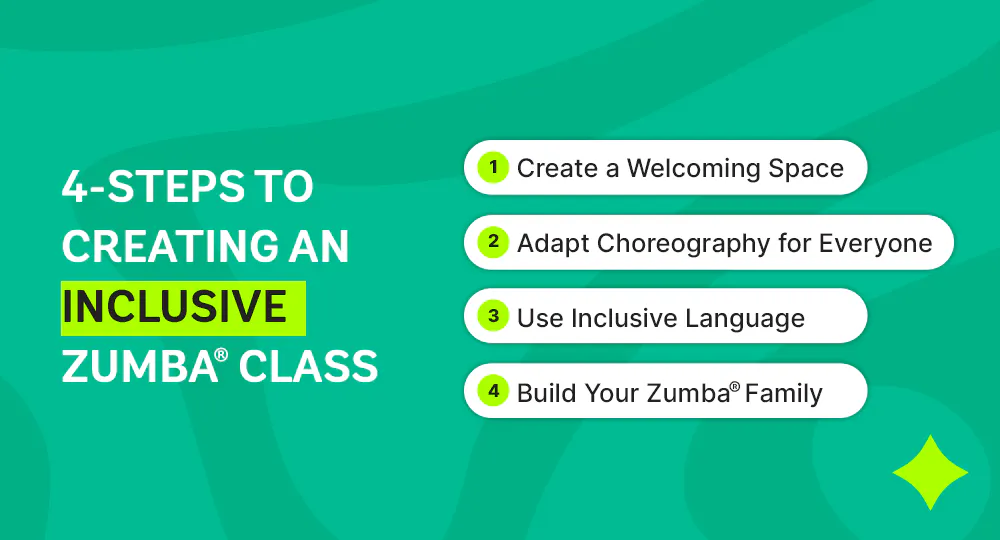
4-Steps to Creating an Inclusive Zumba® Class
Applying the principles of inclusivity to a high-energy, dance-focused class like Zumba® is simple and can make all the difference. The following strategies will help ensure every participant experiences the joy of Zumba®.
1. Create a Welcoming Space
The physical environment for people with varying abilities and your non-verbal cues play a big role in making people feel welcome and at ease.
Consider these details to ensure your space has a welcoming vibe for all:
· The space is physically accessible: Consider physical barriers. Is there a clear path into the room? Is the floor free of trip hazards? If possible, choose venues that are accessible to people with mobility challenges. When setting up, make sure there is enough space for everyone to move comfortably without feeling cramped.
· Small touches count: A genuine smile and a warm greeting as people enter are powerful tools. Have upbeat, family-friendly music playing as people arrive to set a fun, energetic tone. Ensure the space is clean, well-lit, and at a comfortable temperature. These details show you care about your participants' experience.
· Use representative marketing: Make sure your imagery reflects a wide range of people in social media or flyers used to promote classes. Showcase different ages, body shapes, and backgrounds to show that everyone is welcome. This can encourage new people to give your class a try.
· Zumba® virtual classes: For those who can't travel or prefer working out in their own space, they can access the same energetic, instructor-led experience via computer or smartphone. This way, everyone has the opportunity to dance and celebrate movement on their own terms.
2. Adapt Choreography for Everyone
The heart of Zumba® is its vibrant choreography, but a one-size-fits-all approach can leave some participants feeling lost or overwhelmed. The key is to present every routine as a set of options. Empower your students to choose what works for their bodies. When creating an inclusive environment in your group fitness class, offering modifications is a powerful tool.
Here’s how to adapt your choreography to welcome all fitness levels:
· High- and low-impact options: For every move involving jumping or high-impact motion, demonstrate a grounded alternative. For example, instead of a full jump, offer a step-touch or calf raise. For high-knees, show a marching option. Use helpful cues like, "You can follow me with the jump, or take it to a march right here!"
· Complex routines in simple layers: A complex 32-count sequence can be introduced in layers. Start with the footwork for a few reps. Once the class looks comfortable, add the arm movements. This "scaffolding" approach prevents cognitive overload and helps participants feel successful at each stage of learning.
· Movement is the goal: Use your words to take the pressure off. Remind your class that Zumba® is a party, not a performance. Phrases like "There are no mistakes, only accidental solos!" or "As long as you're moving and smiling, you're doing it right!" create a judgment-free zone where people feel free to have fun.
3. Use Inclusive Language
Your words have the power to shape the atmosphere of your class. Choose language that is positive, empowering, and welcoming to everybody. Focus on these key principles for inclusive communication:
· Address the group with inclusive terms like team, everyone, Zumba® crew, or party people. Frame your cues positively, telling people what to do rather than what not to do. For example, "Keep your chest lifted" instead of “Don't slump.”
· Steer clear of phrases that connect exercise to body size, weight loss, or compensating for food choices. So, "Let's burn off that weekend!" or “Get that bikini body!” This type of language can be triggering and reinforces the harmful idea that exercise is punishment.
· Encourage participants to tune into their bodies. Use cues that promote internal awareness, like "Notice how strong your legs feel in this lunge," "Find a rhythm that feels good for you," or "Take a deep breath and feel that energy." This shifts the focus from external appearance to the internal, joyful experience of moving.
4. Build Your Zumba® Family
Encouraging connections between participants enhances their experience and strengthens their commitment to your class. When people feel a sense of belonging, they are more motivated, engaged, and likely to stick with their fitness journey.
Try these simple strategies to build an inclusive environment in your group fitness class:
· Use icebreakers to encourage interaction: Before class starts, play upbeat music and encourage participants to introduce themselves to someone new nearby. You could also use a simple call-and-response during the warmup to get everyone engaged and smiling. Even a simple “High-five your neighbor!” after a tough song can build camaraderie.
· Learn and use participants' names: Making an effort to remember names is an effective way to make someone feel seen and valued. It transforms the dynamic from an anonymous group to a collection of individuals you care about. If you have trouble with names, a simple "Hey, I'm so glad you're here!" can have a similar effect.
· Celebrate shared accomplishments: Acknowledge birthdays, class anniversaries, or congratulate the entire class after they nail a tough routine. Celebrate effort and consistency over performance. This creates a supportive culture where everyone's journey is recognized and valued.
Ready to Lead the Party?
Creating an inclusive environment in your group fitness class is one of the most rewarding things you can do as an instructor. If you're passionate about sharing the joy of movement and building a positive fitness community, becoming a Zumba® instructor is the perfect next step.
As an instructor, you get to be the source of the energy that makes Zumba® special, empowering others and experiencing the fulfillment of changing lives one dance at a time. The Zumba® Basic 1 instructor training is designed to prepare you for this success, giving you the tools and foundational knowledge to lead a safe, effective, and welcoming class for everyone.
Ready to level up? Explore Zumba® Instructor Trainings today!