September 8
Inclusive Fitness
Between school, extracurricular activities, and the endless pull of screens, getting kids to move their bodies can feel like an uphill battle. We know physical activity matters, but finding something that excites them and doesn't feel like another chore is the real challenge. Group fitness classes designed for kids and families turn movement into a social, joyful experience that strengthens family bonds, builds confidence, and creates positive memories kids can carry into adulthood.
The right group fitness program for your family depends on your child's age, personality, and goals. Learn how the right program makes fitness feel less like exercise and more like play, which matters when you're trying to build habits that last beyond a single session.
Why Group Fitness Works Especially Well for Kids and Families
The best options for kids and families share specific characteristics that make them both effective and engaging for young participants:
· Built-in social motivation: Group classes turn exercise from a solitary task into a fun, social event. For kids, seeing their peers move and have fun can create positive peer pressure that may make them more likely to participate and stay engaged.
· Safe space for skill building: A structured class led by a qualified instructor provides a safe environment for kids to learn new movements, improve coordination, and build physical confidence without the fear of judgment. Children can experiment with their bodies, take on new challenges, and discover what they're capable of in a setting designed for growth.
· Dedicated time for family bonding: Sharing a fun challenge or learning a new routine together can create lasting memories and strengthen family connections. The benefits of dance fitness and other group activities extend far beyond the physical workout itself.
· Boosts mental and emotional well-being for all ages: According to the Centers for Disease Control and Prevention, regular physical activity improves memory and attention in children while reducing the risk of depression.
· Instills positive, lifelong habits through play: Group fitness transforms working out into a fun weekly event the whole family can look forward to.
What Makes a High-Quality Group Fitness Program for Kids?
The World Health Organization recommends at least 60 minutes of daily movement for children ages 5-17. Unfortunately, 80% aren't hitting it.
The best options for kids and families share specific characteristics that make them both effective and engaging for young participants:
· Age-appropriate and scalable activities: A quality program should be designed around developmental stages, focusing on foundational motor skills and play for toddlers while introducing more complex skills for pre-teens.
· Variety within sessions: Programs that alternate between high-energy activities and calmer moments match children's natural attention spans. Music, games, and creative elements transform exercise from a chore into play.
· A play-based structure: The best kids' programs disguise exercise as play. They use engaging music, storytelling, and games to introduce concepts like coordination, rhythm, and strength. The structure should be clear but flexible. prioritizing fun and participation over perfect form.
The 7 Best Types of Group Fitness Programs for Families and Kids
When evaluating which types of group fitness programs work best for teaching families or kids, these options consistently rise to the top. Each offers unique benefits, and the right choice depends on your child's personality, interests, and developmental stage.
1. Dance Fitness
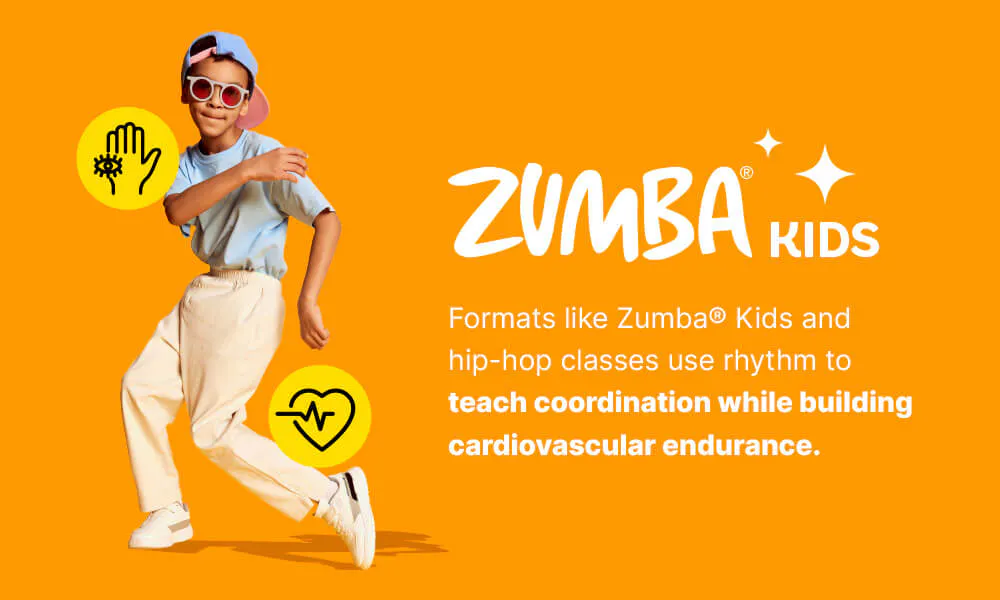
Music drives everything in dance programs, turning movement into play that feels natural to children. Formats like Zumba® Kids and hip-hop classes use rhythm to teach coordination while building cardiovascular endurance. The music-driven approach keeps energy high and makes repetition feel fresh.
Kinesthetic learners can thrive in dance formats because they process information through physical movement. The social aspect helps shy children come out of their shells in a judgment-free environment. Music provides natural motivation, and the performance element gives children chances to showcase what they've learned.
Dance fitness is one of the easiest programs to try because it requires no prior experience or special equipment. Kids can jump in at any skill level and still feel successful from the first class. The skills also transfer beyond the studio, building confidence that shows up at school performances, social events, and everyday life.
2. Yoga and Mindfulness
Yoga offers a calmer, more focused alternative to high-energy dance fitness programs. It's an excellent option for families seeking mindfulness and body awareness.
Family and kids yoga uses playful poses and controlled movements that can help improve physical control. Through poses often named after animals and the natural world, children can increase their flexibility, enhance their balance, and develop greater body awareness in a gentle, non-competitive environment.
3. Circuit Training and Obstacle Courses
Bootcamp-style classes for kids focus on functional fitness through games and team challenges. They can be ideal for children who love adventure and friendly competition.
Stations create the magic in circuit-style classes, rotating children through climbing, jumping, balancing, and problem-solving challenges that keep minds and bodies equally engaged:
· Built-in differentiation: Difficulty scales at each station without disrupting class flow. For example, a rope climb becomes a beginner or advanced challenge simply by adjusting the target height, allowing siblings of different ages to train together.
· Comprehensive fitness: Each station targets different skills and muscle groups, building full-body strength, cardiovascular endurance, and coordination simultaneously.
· Parent appeal: The transferable skills circuit training can help develop agility, balance, and spatial awareness to improve performance in other sports.
4. Martial Arts
Styles like karate, taekwondo, and capoeira combine physical conditioning with mental discipline, teaching children self-defense techniques and values such as respect, perseverance, and self-control.
Parents often turn to martial arts for these benefits:
· Building self-defense awareness and confidence
· Improving focus and academic discipline
· Learning respect for authority, peers, and dojo etiquette
· Practicing goal-setting through belt progression
· Understanding controlled aggression through supervised sparring
Children who train consistently can carry those same habits into the classroom, applying the focus they bring to a kata to their homework and studying.
For families, the structured nature of martial arts can make progress easy to see. The belt system is one of martial arts' most powerful motivational tools. Clear progression markers give children something concrete to work toward, and regular testing cycles create natural goal-setting rhythms that reinforce effort and persistence.
Regular belt testing gives parents a clear window into their child's development, and the discipline children build on the mat may carry over into schoolwork, household responsibilities, and interactions with peers.
5. Water-Based Programs
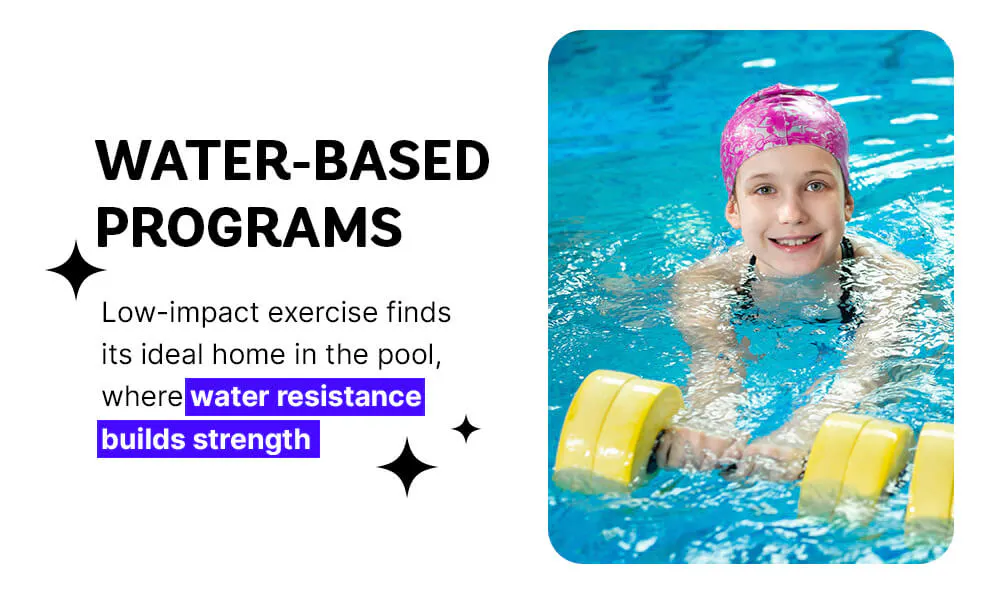
Low-impact exercise finds its ideal home in the pool, where water resistance builds strength while buoyancy can help reduce injury risk. It opens the door to children who may struggle in land-based formats:
· Inclusive by design: Buoyancy can support children of different weights and physical capabilities. The sensory environment also appeals to kids with different learning styles, making this one of the most accessible formats available.
· Built-in safety education: Aqua fitness programs teach water safety alongside physical skills, so your child can build confidence in the water while getting a great workout.
· Medical accommodation: Children with asthma or joint issues can often participate more fully in water-based programs when land-based options aren't possible.
· Year-round consistency: Indoor aquatic facilities can help keep programming on schedule regardless of season, removing the weather-dependent gaps that affect outdoor formats.
6. Sports-Based Programs
For kids who are drawn to competition and teamwork, sports-based fitness programs are a natural fit. Rather than traditional exercise, these classes build athletic ability through games, drills, and structured play. Fundamentals like running, jumping, throwing, and hand-eye coordination are woven into activities that are simply fun.
What makes these programs especially valuable early on is the multi-sport approach. Instead of locking a child into one activity, quality programs rotate through a variety of sports. This might mean soccer one week, basketball the next, and tennis after that. This exposure serves a few important purposes:
· Builds broader physical literacy before specialization begins
· Prevents early burnout from repetitive single-sport training
· Helps families identify which sports genuinely interest their child
· Develops transferable athletic skills that carry across activities
As children progress, the focus shifts from pure movement to understanding the game. Children learn rules, positions, and basic strategy, then apply those in structured game situations. Instructors break complex skills into teachable steps, moving kids from fundamentals to game-ready play at a pace that keeps confidence high. Team-based formats can also teach communication, cooperation, and how to support teammates through wins and losses.
7. Nature and Adventure Programs
Nature and adventure programs take fitness outside, using the natural environment as both the setting and the curriculum. Hiking, climbing, orienteering, rope courses, and nature-based games replace treadmills and weight rooms. Children who resist structured indoor classes often engage more enthusiastically the moment they step outside.
The physical benefits are real and varied. Moving across uneven terrain, navigating trails, and tackling rope courses may build:
· Cardiovascular endurance and functional strength
· Balance, coordination, and spatial awareness
· Problem-solving and decision-making under physical challenge
· Risk assessment and resilience through unpredictable conditions
· Appreciation for nature and the outdoors
The outdoor setting also provides a program that changes on its own. Seasons bring natural variation, from snow-based challenges in winter to water play in summer, keeping the experience fresh. That said, weather dependency is a real operational consideration.
How to Choose the Right Program for Your Family
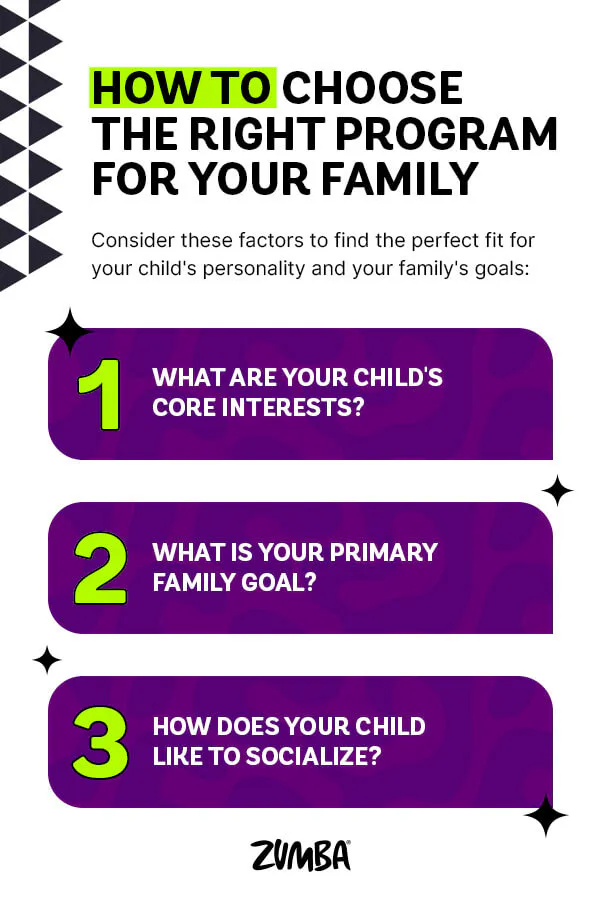
Choosing the right activity is key to keeping your family engaged for the long haul. Consider these factors to find the perfect fit for your child's personality and your family's goals:
· What are your child's core interests? If your child is constantly dancing around the living room, loves music, and has a flair for the dramatic, a dance fitness program like Zumba® is a perfect match. Its high-energy, party-like atmosphere is designed specifically for kids who love to move and express themselves.
· What is your primary family goal? If your main goal is to introduce calm, focus, and mindfulness into a hectic schedule, slower programs may be an excellent choice. If you're aiming to build foundational athletic skills and teamwork through friendly competition, a kid-friendly, high-energy environment could be ideal.
· How does your child like to socialize? Consider the social dynamic that best suits your child. For example, if they thrive in a vibrant, celebratory group setting where everyone is doing their own thing together, a Zumba® class may be the best fit.
Frequently Asked Questions
Get your pressing questions on group fitness programs for families answered.
1. What Age Can Children Start Group Fitness Classes?
Structured group fitness programs may accept children as young as 3-4 years old, though these early classes might focus on movement exploration and parent participation rather than formal exercise. By ages 5-7, children can generally follow multistep instructions and engage in more structured activities such as high-energy dance fitness or martial arts.
2. How Do I Get My Child Interested in Fitness if They Resist Traditional Sports?
Start by removing the word "exercise" from the equation. Many children resist fitness because they associate it with competition, pressure, or activities that don't align with their personalities. The key is finding a format that feels like play rather than a workout. Dance fitness programs like Zumba® Kids work especially well for reluctant movers because the music and energy make it nearly impossible to stand still.
3. Can My Child Join a Group Fitness Class With No Prior Experience?
Absolutely. Most kids' group fitness programs are designed for beginners, and many children walk into their first class with zero background in structured exercise. Good programs meet kids where they are, offering modifications and progressions so every child can participate at their own level.
4. Are Group Fitness Classes Safe for My Child?
When led by a qualified instructor and designed for the appropriate age group, group fitness classes are generally very safe for children. Quality programs build activities around developmental stages, starting with foundational movements and scaling up as children grow stronger and more coordinated. Look for classes with attentive instructors, clear structure, and manageable class sizes.
Experience Family Fitness With Zumba®
Group fitness has the power to transform how families connect and how individuals build meaningful careers. Zumba® stands out as the solution that delivers on both fronts, offering a globally recognized, high-energy program that kids genuinely love and access to built-in support that sets you up for success.
For parents ready to get started, finding a class is simple. With thousands of instructors teaching worldwide, there's likely a class happening near you right now. Find a Zumba® Kids class near you and give your family the gift of movement, music, and memories.